
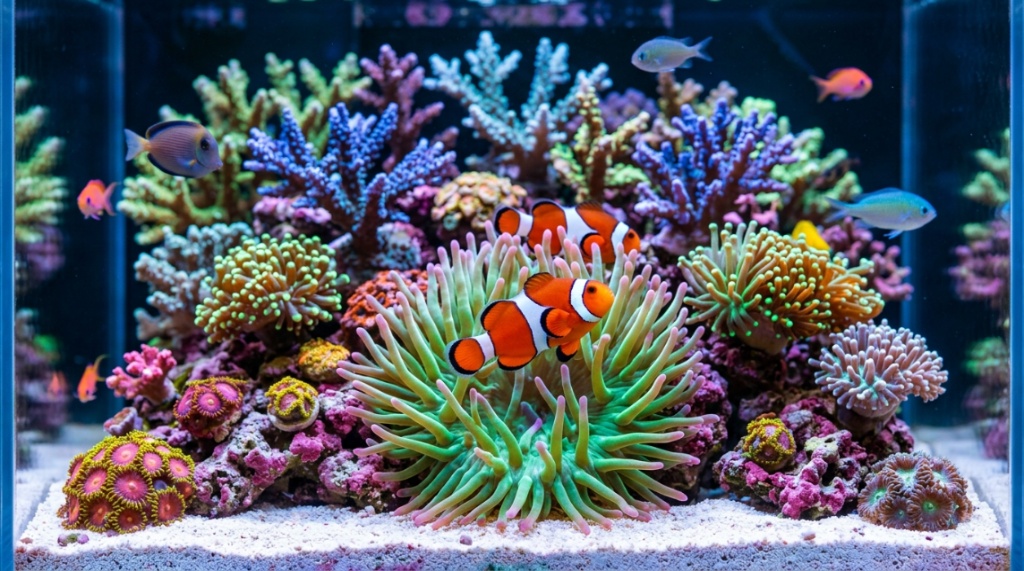
You bought a beautiful saltwater tank, set it up meticulously, and added your first clownfish. Everything looks perfect. But a nagging question keeps you up at night: is the salt level right? You know that getting this wrong can spell disaster for your coral or fish.
but you have no idea how frequently you need to monitor it. You are not alone. Many aquarists struggle with balancing water changes, evaporation, and equipment drift. The truth is that neglecting consistent aquarium salinity testing is the number one cause of osmotic shock and mysterious coral losses. In this guide, I will give you a precise schedule, explain why frequency matters, and show you the practical steps to keep your marine ecosystem stable.
What Exactly Is Salinity and Why Does It Change?
Salinity is the total concentration of dissolved salts in your aquarium water, measured in parts per thousand (PPT) or specific gravity (SG). It is the foundation of osmoregulation for every fish and invertebrate in your tank.
Salinity does not stay static. It changes mainly because of evaporation. When water evaporates, the salts remain behind, causing the salinity to rise. Your equipment also plays a role. Protein skimmers and filters remove water, and dosing pumps can accidentally add or remove trace elements. Even salt creep around the rim of your tank slowly removes salt from the water column, lowering your reading slightly over weeks.
Common Causes of Salinity Drift
- Evaporation: The biggest factor. In a standard 50-gallon reef tank, you can lose up to a gallon of water per day.
- Water Changes: If your new saltwater mix is slightly off, you introduce drift immediately.
- Equipment Issues: Faulty auto top-offs (ATO) or leaking pumps.
- Accidental Spills: Splashing water out while cleaning glass.
Understanding these causes helps you predict when you need to test. A tank with high evaporation needs more frequent checks than a sealed system with an ATO.
How Often Should You Test Salinity in a New Aquarium?
During the first month, test salinity every single day. New tanks are unstable, and your biological filter is still maturing. Salinity swings during the nitrogen cycle can stall bacterial growth or kill sensitive live rock.
When you first fill a new tank, the salt mix may not be perfectly uniform. You might have hot spots of higher salinity near the bottom. Daily testing helps you verify that your circulation pump is fully mixing the water. Once you confirm stability for at least two consecutive weeks, you can reduce the frequency.
Daily Testing Checklist for New Tanks
- Check specific gravity at the same time each day (morning is ideal).
- Record the reading in a logbook.
- Adjust evaporation immediately with fresh RODI water.
- Never add saltwater to correct evaporation; use fresh water only.
Once your cycle completes and you add fish, continue daily testing for at least another week. After that, you can move to a maintenance schedule.
What Is the Ideal Testing Frequency for a Mature Reef Tank?
For a mature reef tank (6+ months old) with a functioning auto top-off system, test salinity at least twice per week. If you do not have an ATO, you must test every other day.
A mature tank has a stable bacterial population and robust coral growth, but it is still vulnerable to slow drift. A change of 0.001 in specific gravity (about 0.5 PPT) might not kill a fish immediately, but it stresses corals over time. Testing twice weekly catches small drifts before they become dangerous.
Why Twice Weekly Works
- It catches weekend evaporation after a busy week.
- It accounts for water changes performed on the weekend.
- It reveals if your ATO float valve is sticking or failing.
If you notice that your readings are consistently perfect for a month, you might stretch to once a week. However, I recommend keeping the twice-weekly habit because it trains you to notice other subtle changes in water quality.
How Does Evaporation Affect Your Testing Schedule?
Evaporation rate determines your testing frequency more than any other factor. In a dry climate or during winter with artificial heating, a tank can lose 2% of its volume daily. That means your salinity rises by roughly 0.0005 SG per day. Over a week, that adds up to a dangerous 0.0035 SG swing.
If you live in a humid area or keep the tank covered, evaporation slows down significantly. You might only need to test weekly. The key is to know your specific evaporation rate. Measure how much water your ATO reservoir uses in 24 hours, then calculate the percentage of tank volume lost.
Evaporation Adjustment Guide
| Tank Setting | Evaporation Rate | Recommended Testing Frequency |
|---|---|---|
| Open top, high air flow | 1-2% daily | Every other day |
| Glass lid, low air flow | 0.2-0.5% daily | Once a week |
| With auto top-off | Variable | Twice per week |
| No auto top-off | Any rate | Daily or every other day |
Track your evaporation for two weeks to determine your baseline. If your tank loses a gallon per day, you must test before each top-off session.
When Should You Test After a Water Change?
Always test salinity immediately after mixing new saltwater, then test again 1 hour after adding it to the tank. A poorly mixed batch can have a different salinity than your display tank.
Many aquarists mix saltwater for 24 hours before use. Even with that preparation, the final salinity can drift. Always adjust your mix before adding it to the tank. Once you add the water, wait one hour for full circulation, then test your display tank to confirm the change did not swing your overall salinity.
Water Change Testing Protocol
- Test your reservoir mix before pouring.
- Add the new water slowly over 10-15 minutes.
- Wait 60 minutes for mixing.
- Test the display tank.
- Log both values.
If the difference between reservoir and tank is greater than 0.001 SG, your mixing process needs improvement. Use a powerhead or heater in your mixing bin to ensure uniformity.
Is Daily Testing Necessary for Fish-Only Tanks?
Fish-only saltwater tanks are more forgiving than reef tanks, but you should still test at least once a week. Fish are hardy, but rapid salinity changes cause stress and disease outbreaks like marine ich.
In a fish-only system, you have no corals to buffer pH, so salinity can shift faster due to biological activity. Also, fish produce more waste, which can interact with salt chemistry. Weekly testing catches problems before your fish show symptoms.
When to Test More Frequently in Fish-Only Tanks
- After introducing new fish (daily for 5 days).
- After a large water change (test immediately and next day).
- If you see fish flashing or scratching against rocks.
- During temperature swings in the tank (summer heat waves).
One advantage of fish-only tanks is that you can tolerate a slightly wider range (1.020 to 1.025 SG). However, consistency remains far more important than the exact number.
What Tools Do You Need for Accurate Testing?
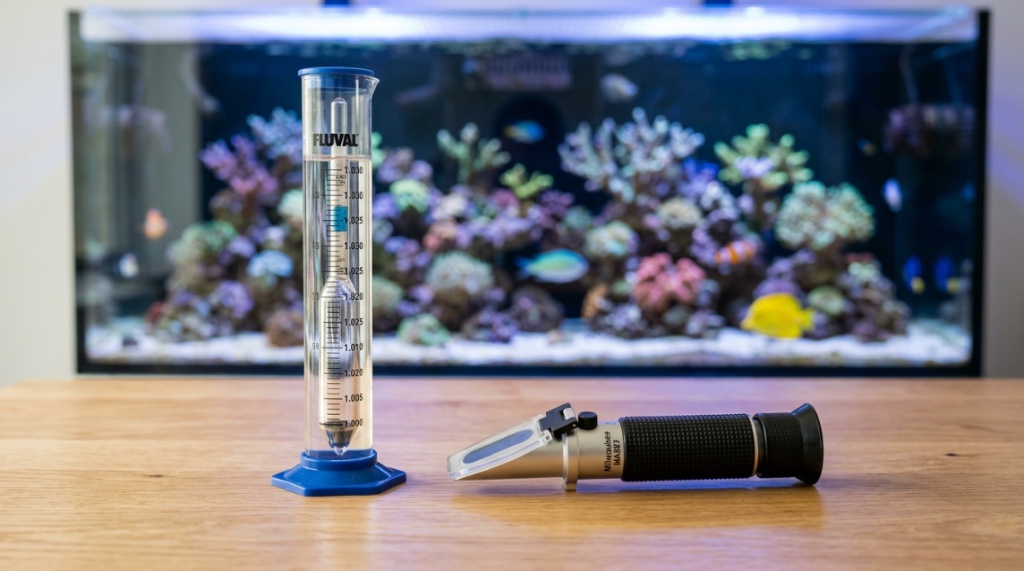
You need a reliable salinity meter or refractometer. Hydrometers are cheap but unreliable due to bubble adhesion and temperature sensitivity. I recommend a digital refractometer or a conductivity meter for the best accuracy.
Digital meters give you instant readings in PPT or SG and compensate for temperature automatically. Analog refractometers require calibration with RODI water before each use. Whichever tool you choose, calibrate it monthly with a standard solution.
Pros and Cons of Testing Tools
| Tool | Accuracy | Ease of Use | Cost |
|---|---|---|---|
| Hydrometer (plastic swing-arm) | Low (±0.002 SG) | Easy | $5-$15 |
| Analog Refractometer | Medium (±0.001 SG) | Moderate | $30-$60 |
| Digital Refractometer | High (±0.0005 SG) | Very easy | $100-$250 |
| Conductivity Probe (controller) | Very high (±0.0001 SG) | Automated | $200-$500+ |
Investing in a quality meter eliminates guesswork. If you are serious about reef keeping, a digital refractometer or a controller with a conductivity probe is worth every penny.
Can You Over-Test Salinity?
Technically no, but you can create problems by over-correcting. Testing too frequently is not harmful, but reacting to every tiny fluctuation by adding salt or water is dangerous.
Salinity naturally fluctuates within a small range throughout the day due to feeding, temperature changes, and biological activity. A variation of 0.0005 SG is normal and harmless. Over-testing leads to unnecessary adjustments, which destabilize your tank. Stick to your schedule and only make adjustments if your reading falls outside your target range.
When to Take Action
- If your specific gravity drops below 1.023 SG (for reefs) or 1.019 SG (for fish-only).
- If your specific gravity rises above 1.026 SG (for reefs) or 1.028 SG (for fish-only).
- If you see a change of more than 0.002 SG in a single week.
Patience is your best tool. Small drifts can be corrected slowly over several days with gentle top-offs or salt additions.
Maintaining stable salinity is notoriously difficult in smaller volumes of water due to rapid evaporation. If you are managing a compact marine setup, pair your routine testing with the Best Cheap Filters for Small Aquariums and Nano Tanks to ensure consistent water movement and optimal filtration without breaking the bank.
How to Build a Sustainable Testing Routine
Turn testing into a habit by linking it to an existing weekly task. For example, test salinity every Monday and Thursday when you feed your corals. Make it part of your water change ritual.
- Set reminders: Use your phone calendar with recurring alarms.
- Keep tools accessible: Store your refractometer, calibration solution, and logbook next to the tank.
- Create a simple log: Note date, reading, and any adjustments made.
- Review monthly: Look for trends like a slow upward drift that signals a failing ATO.
Sample Weekly Schedule for Reef Tanks
- Monday: Test salinity in the morning. Adjust top-off if needed.
- Wednesday: Mix new saltwater for upcoming water change. Test mixing bin.
- Thursday: Perform water change. Test tank 1 hour later.
- Saturday: Quick check on salinity and temperature.
Consistency is key. If you skip a week, you lose the ability to spot trends. A single bad reading after two weeks of neglect is hard to interpret.
What Happens If You Ignore Salinity Testing?
Ignoring salinity testing leads to one of three outcomes: osmotic shock, coral bleaching, or a slow decline in fish health. High salinity forces fish to work harder to maintain fluid balance, damaging their kidneys over months. Low salinity stresses corals, causing tissue loss and algae overgrowth.
The scariest scenario is a rapid drop due to a large water change with incorrect mix. A drop of 0.005 SG in one hour can kill sensitive inverts like shrimp and anemones instantly. Fish may survive but will be lethargic and prone to disease for weeks.
Signs You Have Been Neglecting Salinity
- Fish swimming erratically or gasping at the surface.
- Corals not opening fully or showing retracted polyps.
- Excessive algae growth due to stressed or dying organisms.
- Unexplained deaths of snails or hermit crabs.
If you see these signs, test salinity immediately. Do not assume it is another problem. Rule out the most common cause first.
Frequently Asked Questions
Can I use a simple hydrometer instead of a refractometer?
Yes, but expect less accuracy. Hydrometers are cheap and fine for fish-only tanks. For reef tanks or sensitive systems, a refractometer is far more reliable and worth the investment.
What is the perfect salinity for a saltwater aquarium?
For most fish-only tanks, aim for 1.020 to 1.025 SG (30-35 PPT). For reef tanks with corals, 1.024 to 1.026 SG (33-35 PPT) is ideal. Consistency within your target range matters more than hitting an exact number.
How long does it take for salinity to stabilize after a water change?
It takes about 30 to 60 minutes for full mixing in a well-circulated tank. Always wait at least one hour before testing after a water change.
Should I test salinity in the morning or evening?
Test at the same time every day. Morning is ideal because evaporation overnight has not yet peaked, giving you a more stable baseline reading.
Can I adjust salinity by adding salt directly to the tank?
No. Never add dry salt directly to the display tank. Salt crystals can burn fish gills and create dangerous hot spots. Always dissolve salt in fresh water before adding.
Does temperature affect my salinity reading?
Yes. Both analog and digital meters are temperature-sensitive. Always use a meter with automatic temperature compensation (ATC) or read the temperature correction chart for your tool.
How often should I calibrate my refractometer?
Calibrate your refractometer at least once a month using a 35 PPT calibration solution or RODI water. Always calibrate before a critical test like after a water change.
Conclusion
Testing aquarium salinity is not optional, it is the single most important parameter you can monitor. For a new tank, test daily until stability emerges. For a mature reef tank with an ATO, twice weekly is your sweet spot. Fish-only tanks can get away with weekly checks, but never skip a week entirely. Your testing routine does not need to be complex. Pair it with existing tank chores, use a reliable meter, and log your results. The peace of mind you gain is priceless. More importantly, your fish and corals will thrive in a stable environment. Start your new routine today, and you will immediately notice healthier, more active livestock.