
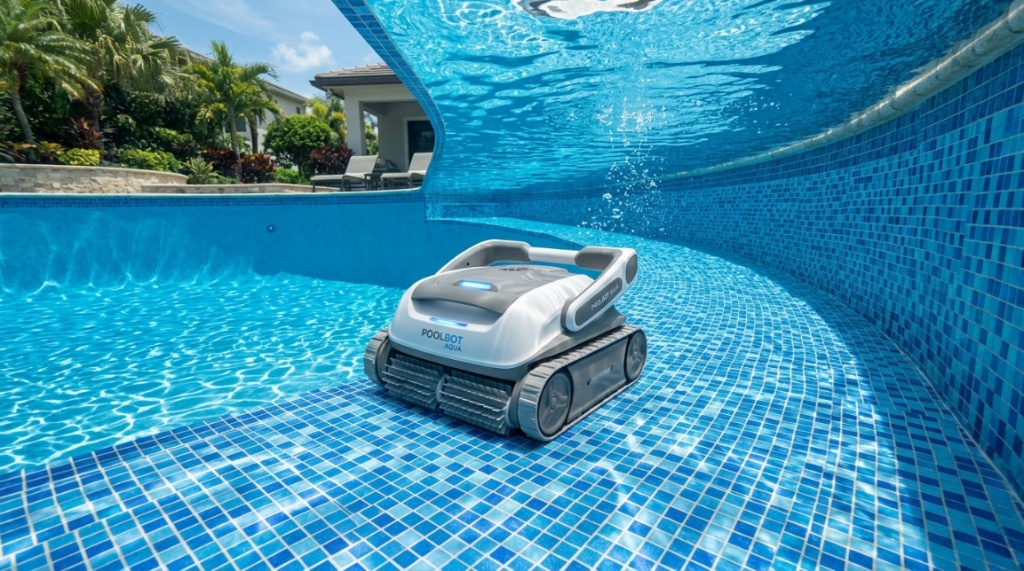
If you own a pool, you already know the drill: scrubbing walls, vacuuming the floor, and wrestling with tangled hoses eats into your weekends. Maybe you’ve seen the newer generation of cleaning devices and wondered whether they’re genuinely different or just another gadget. A cordless robotic pool cleaner promises to eliminate the hassle of connecting hoses to your skimmer and dealing with tangled cables. But how does it actually work, and is it the right choice for your pool? This article explains the technology behind these devices, what they can and cannot do, and how to decide if one deserves a spot in your maintenance routine.
Key Takeaways
- Cordless robotic pool cleaners operate independently with a rechargeable battery and do not connect to your pool’s filtration system or a wall outlet.
- They use internal motors, brushes, and intelligent navigation to climb walls, scrub tile, and collect debris into a self-contained filter cartridge.
- Battery life typically ranges from 90 to 150 minutes, which is sufficient for most residential pools but requires planning for larger pools.
- Look for features like dual drive motors, gyroscope navigation, and fine filter cartridges if you want thorough cleaning and strong debris pickup.
- While they cost more upfront than suction-side or manual cleaners, the convenience and energy savings can justify the investment for many pool owners.
Understanding Cordless Robotic Pool Cleaners
In simple terms, a cordless robotic pool cleaner is a self-contained, battery-powered device that moves through your pool to clean the floor, walls, and waterline. Unlike traditional suction-side cleaners that attach to a dedicated suction line or skimmer, and unlike pressure-side cleaners that rely on a booster pump, a robotic cleaner operates completely independently. You place it in the water, press a button, and let it work. It runs on an internal rechargeable battery, which means there is no cord to untangle and no need to plug anything in while it works.
This is more than a minor convenience. If you have ever spent an afternoon untangling a 40-foot hose or carefully managing a cable from an outlet across your yard, you understand the appeal. The cordless design removes the physical connection between the cleaner and your pool’s existing equipment entirely, which also means it does not add pressure or load to your filter pump system.
The Anatomy of a Cordless Robotic Cleaner
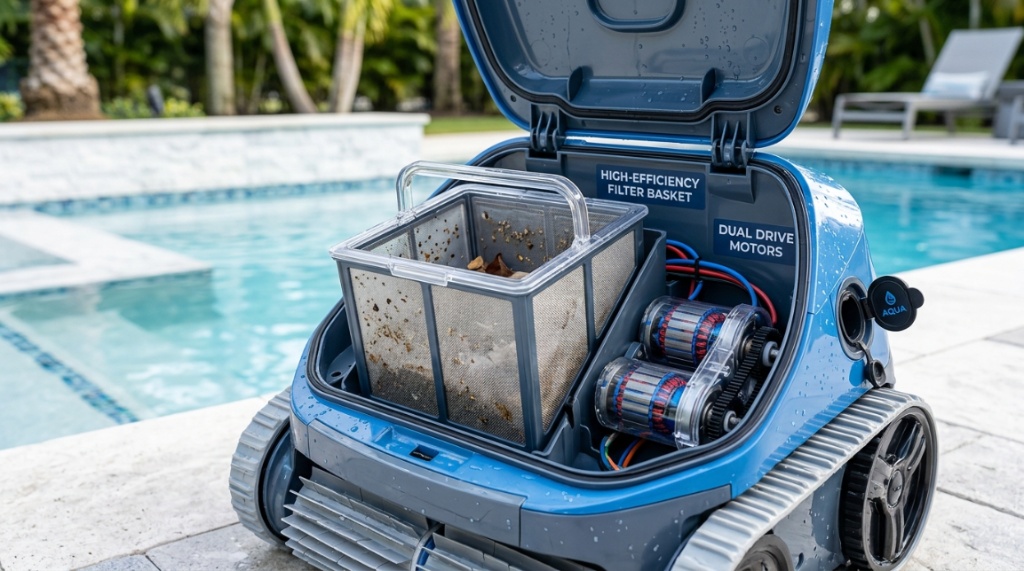
To understand how these machines work, it helps to look at their core components. A typical cordless robotic pool cleaner consists of several key parts working together:
- Rechargeable battery: Usually a lithium-ion unit that provides the energy for all operations. Runtime varies from about 60 minutes for compact models to over two hours for premium units.
- Drive motors: At least two motors power the wheels or tracks, moving the cleaner around the pool. More powerful motors provide better climbing ability and faster movement across surfaces.
- Brush rollers: These are typically made of rubber or plastic and rotate to scrub the pool floor and walls. Some models use a combination of brushes to handle different debris types.
- Filter cartridge(s): Debris is pulled into a self-contained filter compartment. The filter captures dirt, leaves, sand, and even fine particles, depending on the filter mesh quality.
- Impeller or suction motor: This creates water flow that draws debris toward the filter. The strength of the suction affects how quickly the cleaner picks up material.
- Navigation system: More advanced models use gyroscopes, accelerometers, and even AI vision or mapping technology to steer systematically across the pool. Simpler models rely on random patterns.
- Floating cable or top handle: Many cordless models have a small floating cable or a top-mounted handle that you use to lift the cleaner out of the water after it finishes.
How Does a Cordless Robotic Pool Cleaner Actually Clean?
The cleaning process is both simple in concept and sophisticated in execution. Once the cleaner is submerged and turned on, the drive motors propel it forward and in turning patterns across the pool floor. The brush rollers spin independently of the drive wheels, which allows the cleaner to scrub surfaces while moving. Simultaneously, the suction motor draws water inward, carrying debris along with it into the filter chamber.
What surprises many pool owners is the climbing ability of these devices. High-quality cordless robotic cleaners can ascend vertical walls and even reach the waterline. They do this by generating enough thrust from their motors to hold the cleaner against the wall while the brushes and wheels work together to move upward. Once at the top, the cleaner scrubs the tile line and waterline area before moving back down. This climbing feature is not just a novelty. In-ground pools almost always accumulate algae, grime, and scum at the waterline, and surfaces like plaster or fiberglass need regular scrubbing to stay clean.
Navigation: Random Bump vs. Systematic Mapping
One of the biggest differences between budget and premium models is how they navigate. Basic cordless models use a random or “bump-and-turn” pattern. They move in a straight line until they crash into a wall or step, then rotate at a set angle and continue. Over a full cleaning cycle, this random pattern covers most of the pool, but coverage is not guaranteed, and some areas may be visited multiple times while others are missed entirely.
Higher-end models, including many from reputable brands, use gyroscopes to track their position and orientation. This allows them to follow organized, back-and-forth rows across the floor, then shift to a vertical pattern for walls, then transition to the waterline. Some advanced units even use AI or map-based navigation to adapt their route based on the pool’s shape and size. The result is significantly faster and more complete cleaning. If you have an irregularly shaped pool, such as a freeform design, or if you simply want consistent results without spot-checking, a model with smart navigation is worth the upgrade.
What Are the Real Benefits of Going Cordless?
So why choose a cordless robotic pool cleaner over a traditional corded robotic model or a pressure-side cleaner? There are several distinct advantages that make this category attractive for many pool owners.
Complete Freedom from Cables and Hoses
This is the headline feature. With a cordless model, there is nothing to untangle, no cord to trip over, and no need for an electrical outlet near the pool. You simply charge the unit, drop it in the water, and pull it out when it finishes. For pools located far from a house outlet, or for people who are tired of wrestling with cables, this removes a significant source of frustration.
No Connection to Your Pool’s Filtration System
Because the cleaner operates independently, it does not use your skimmer, pump, or filter. This has a few benefits. First, it does not add resistance or strain to your existing circulation system. Second, it keeps all the dirt and debris it picks up in its own cartridge, rather than sending a cloud of fine sediment back to your main filter. Third, it allows you to run a cleaning cycle even when your pool pump is off, which can be useful for overnight cleaning or when you want to run your pump on a reduced schedule.
If you have had issues with your main filter getting clogged or your pump cycling frequently, a cordless robotic cleaner can actually help reduce the load on those components because it handles heavier cleaning tasks on its own. This can lead to energy savings over time, especially if you can shorten your pump runtime while maintaining a clean pool.
Easy Storage and Portability
Most cordless robotic pool cleaners are relatively lightweight, often between 10 and 20 pounds. Since there is no cord to wind and no control box to mount on the wall, storage is simpler. You can also carry them easily to the pool edge without hauling a tangle of cables. This portability also makes them a practical option for above-ground pools, where running power cords to a control box is often inconvenient or a safety concern.
For a closer look at a specific model with advanced features like AI vision and the benefits of cordless operation, you can check out this review of a cordless robotic pool cleaner designed to handle demanding cleaning conditions.
What Are the Trade-offs and Limitations?
No product is perfect, and cordless robotic cleaners have some limitations you should consider before buying one. Understanding these trade-offs will help you choose the right model and avoid disappointment.
Battery Life and Pool Size
The most obvious limitation is battery life. Most cordless models run for 90 to 150 minutes per charge, depending on the battery capacity and how much work the cleaner is doing. Climbing walls and scrubbing the waterline uses more energy than simply rolling across the floor. If you have a large pool, say over 40 feet in length, or a pool with extensive wall surface, the cleaner may finish its cycle before covering everything thoroughly. You will then need to recharge and run a second cycle, which may not be ideal.
Before purchasing, consider the actual surface area of your pool, not just its length and width. A pool with deep walls and a wide waterline will require more runtime. Some manufacturers list the recommended maximum pool size for their products. Pay close attention to those numbers, and if you are near the limit, you may want to look for a model with a longer runtime or one that offers a quick-charge feature, To ensure your indoor environment stays just as pristine as your outdoor swimming space while using heavy-duty maintenance equipment, read our guide on how HEPA vacuum cleaners improve indoor air quality.
Cleaning Time Can Be Longer
Because the battery limits the total working time, some cordless models are programmed to clean less thoroughly in a single cycle than their corded counterparts. For example, a corded robot that runs for 2.5 hours may make several passes over the same area, while a cordless robot in a 90-minute cycle might only make one or two passes. This is fine for routine maintenance, but if you have heavy debris, construction dust, or algae blooms, you may need to run a couple of back-to-back cycles or manually brush the pool first.
Lifting and Retrieving the Cleaner
With a corded robot, you pull the device out by the floating cord. With a cordless model, you need to reach into the pool and grab the cleaner, ideally by a handle integrated into the top or side. For in-ground pools with a deep center, this can require a pool pole with a hook or a reaching device. Some newer models include a floating handle that makes retrieval easier, but it is still an extra step compared to the pull-out convenience of a corded robot. Also, after retrieving the unit, you must open the filter compartment, rinse out the cartridge, and recharge the battery. This is a straightforward process but one you will repeat after every cycle.
How to Choose the Right Cordless Robotic Pool Cleaner
Choosing the right cordless cleaner comes down to matching the device to your pool’s specific needs and your personal priorities. There is no single “best” model for everyone, but there are clear decision criteria that will narrow down your options.
Match the Cleaner to Your Pool Surface
Different pool surfaces require different brush types. Vinyl pools are easily scratched, so they need soft, gentle brushes. Fiberglass pools also benefit from softer brush material to avoid dulling the gel coat. Concrete, plaster, and gunite pools require more aggressive scrubbing to remove algae, scale, and dirt that cling to porous surfaces. Some cleaners come with interchangeable brush rollers, allowing you to swap between a gentle brush for daily cleaning and a more aggressive one for deeper scrubbing. If your pool has a single surface type, you can focus on models that come with brushes designed for that material.
Consider Filter Capacity and Type
The filter cartridge is the workhorse of the machine. Look for a model that offers a filter with fine mesh pores to capture small particles like pollen, dust, and algae residue. A fine fabric filter is preferable over a coarse one if you care about water clarity. Additionally, consider the ease of cleaning the filter. Some cartridges can be rinsed quickly with a garden hose, while others require disassembly and a more thorough scrubbing. A larger filter cartridge means the cleaner can run longer before its holding capacity decreases, which is a real advantage in pools that collect a lot of leaves or sand.
Think About Navigation and Coverage
As explained earlier, navigation is a major differentiator. If you have a simple, rectangular, kidney-shaped pool and do not mind a slightly longer cleaning time, a random-bump model is budget-friendly and adequate. If you have an in-ground pool with steps, uneven areas, or an irregular shape, or if you want to set the cleaner and trust that it will cover everything efficiently, choose a model with gyroscope or AI-assisted mapping. The extra cost translates into better coverage, fewer missed spots, and usually a shorter cleaning run because the cleaner does not waste time back-tracking.
Check the Warranty and Build Quality
Waterproofing and electronic reliability are critical. Look for models with IPX8 waterproof rating or explicit manufacturer claims about watertight construction. A robust warranty, typically 12 to 24 months, offers peace of mind for a device that costs several hundred dollars. Also, pay attention to the quality of the battery and whether it can be replaced. Eventually, all rechargeable batteries degrade. If the battery is sealed into the unit, you may need to replace the whole cleaner after a few years. Models with user-replaceable batteries are more economical in the long run.
Maintenance and Best Practices
To get the best performance and a longer lifespan from your cordless robotic pool cleaner, follow these simple practices:
- Rinse the filter after every use: Debris left in the filter will decompose and clog the mesh, reducing suction and making cleaning more difficult. A quick rinse is inexpensive insurance.
- Store the cleaner out of direct sunlight: Prolonged exposure to UV rays can degrade rubber brushes, plastic housings, and battery health. Store the unit in a garage or shaded area when not in use.
- Remove the cleaner promptly after it finishes: Leaving it in the water for long periods, especially in chlorinated pools, is not necessary and can put unnecessary wear on seals and gaskets.
- Protect the battery during winter: If you live in a climate with freezing temperatures, bring the cleaner indoors and store the battery properly. Do not store the battery fully discharged for months at a time.
- Check the brushes periodically: Hair, string, and small objects can wrap around the brush rollers. If you notice the cleaner leaving streaks or taking longer than usual, inspect and clean the brushes.
Is a Cordless Robotic Pool Cleaner Worth It for Your Pool?
If you value your time and want a hassle-free way to keep your pool clean, a cordless robotic pool cleaner is a worthwhile investment. It is particularly well-suited for small to medium-sized in-ground pools and most above-ground pools, where battery life is sufficient for a complete cleaning cycle. The lack of a cord is not just a minor feature. It changes how you use the cleaner, making it easier to store, safer to use, and less dependent on your pool’s filter system.
However, if you have a very large in-ground pool (over 50 feet in length) or you routinely deal with heavy debris and need the longest possible cleaning time, you may want to consider a corded robotic cleaner. Corded models run as long as they are plugged in, are generally more powerful in terms of suction, and do not require battery management. They are less convenient to handle, but they offer performance that some cordless models cannot match in a single cycle.
Frequently Asked Questions
How long does a cordless robotic pool cleaner battery last?
Most cordless robotic pool cleaners run for approximately 90 to 150 minutes on a single charge. Actual runtime depends on the model and the cleaning workload. Climbing walls and scrubbing the waterline drains the battery faster than cleaning only the pool floor.
Can a cordless robotic pool cleaner climb walls?
Yes, many cordless models can climb vertical walls and clean the waterline. However, climbing ability varies by model. Check the product specifications for wall-climbing capability if that is important for your pool’s cleaning needs.
Do I need to run my pool pump while the robotic cleaner is working?
No. Because cordless robotic pool cleaners have an internal pump and filter, they operate independently of your pool’s circulation system. You can run the cleaner with the pump off, which is useful for evening or overnight cleaning.
How often should I use a cordless robotic pool cleaner?
For most residential pools, running the cleaner once every day or every other day is sufficient to maintain clarity and prevent debris buildup. During periods of heavy use or when leaves are falling, you may need to run it more frequently.
Are cordless robotic pool cleaners safe for vinyl or fiberglass pools?
They are safe if you choose a model with appropriate soft brush rollers. Many models are designed specifically for delicate surfaces. Always check the manufacturer’s guidelines regarding compatibility with your specific pool material.
Conclusion
A cordless robotic pool cleaner removes the cables, hoses, and hassle from pool maintenance while delivering reliable floor, wall, and waterline cleaning. By understanding how these devices work, what their limitations are with battery life and navigation, and what features matter most for your pool, you can make a confident choice. The convenience of a cordless design makes it easier to keep up with routine cleaning, which pays off in a clearer pool and more free time. Assess your pool size, surface type, and daily debris load, then choose a model that offers the runtime, brushes, and smart navigation your pool deserves.