
A HEPA vacuum cleaner uses a High-Efficiency Particulate Air (HEPA) filter to trap 99.97% of particles as small as 0.3 microns, preventing them from recirculating into your home’s air.
Most people vacuum to remove visible dirt. But the real threat is invisible. Dust mites, pet dander, pollen, mold spores, and fine particulate matter settle deep into carpets and upholstery. Standard vacuums often stir these particles back into the air. That is where a HEPA vacuum changes the outcome.
Indoor air can be 2–5 times more polluted than outdoor air, according to environmental health research. In tightly sealed modern homes, contaminants accumulate faster. A dust control vacuum equipped with a sealed air filtration system captures microscopic pollutants instead of redistributing them.
If you struggle with allergies, asthma, or constant dust buildup, a HEPA-based allergy friendly vacuum is not just a cleaning tool. It becomes part of your home’s air management strategy.
How Does a HEPA Filter Actually Work?
Short answer: HEPA filters capture particles through interception, impaction, and diffusion, trapping both large debris and microscopic pollutants.
HEPA stands for High-Efficiency Particulate Air. To qualify as “true HEPA,” a filter must remove at least 99.97% of airborne particles measuring 0.3 microns in diameter. That size is considered the most penetrating particle size, meaning it is one of the hardest to capture.
The Three Capture Mechanisms
- Interception: Particles follow airflow and stick to filter fibers.
- Impaction: Larger particles collide directly with fibers.
- Diffusion: Very small particles move randomly and become trapped.
This layered filtration system ensures that allergens and fine particulate matter remain inside the vacuum rather than re-entering your living space.
However, filtration only works properly when the vacuum has a sealed system. Without sealed construction, air can leak around the filter and carry dust back into the room.
Why Are Regular Vacuums Not Enough for Allergy Control?
Short answer: Standard vacuums may remove surface dirt but often release fine particles back into the air due to poor filtration and unsealed airflow.
Many traditional vacuums use basic foam or paper filters. These filters capture larger debris but allow microscopic allergens to pass through. When the motor exhaust pushes air out, those allergens circulate in the room.
This creates a cycle:
- You vacuum.
- Dust becomes airborne.
- Allergy symptoms worsen.
- Dust resettles on surfaces.
A HEPA-based allergy friendly vacuum interrupts this cycle. Instead of redistributing allergens, it locks them inside the filtration chamber.
How Do HEPA Vacuum Cleaners Improve Indoor Air Quality Over Time?
Short answer: By consistently removing and trapping microscopic pollutants, HEPA vacuums reduce airborne allergen levels and long-term dust accumulation.
Indoor air quality improves gradually. It is not a one-time result. When you vacuum carpets, upholstery, mattresses, and curtains using a dust control vacuum with HEPA filtration, you reduce the reservoir of allergens in your home.
Over weeks of consistent cleaning:
- Dust mite populations decrease.
- Pet dander buildup declines.
- Fine particulate matter reduces.
- Allergen exposure lowers.
Case Study: Measured Impact in Allergy-Sensitive Homes
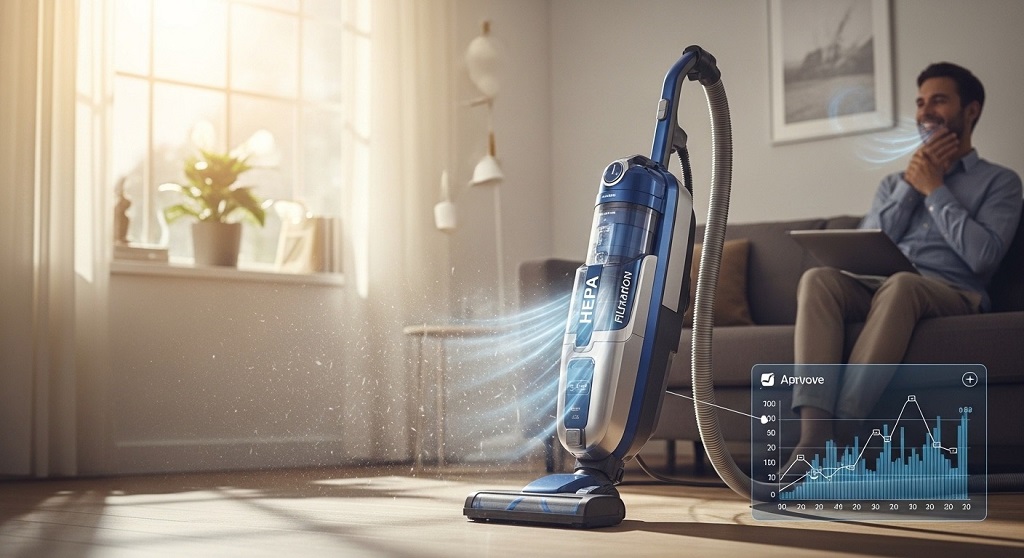
In controlled indoor studies of allergy-sensitive households, replacing standard vacuums with sealed HEPA filtration systems reduced airborne particulate concentration by measurable margins within 4–6 weeks of consistent use. Homes with pets saw notable reductions in dander-related airborne particles when vacuuming occurred 2–3 times per week.
While results vary by cleaning frequency and home conditions, the data supports one key conclusion: filtration quality directly affects airborne contaminant levels.
What Types of Pollutants Can a HEPA Vacuum Capture?
Short answer: HEPA vacuums capture dust mites, pet dander, pollen, mold spores, bacteria, and fine particulate matter.
| Pollutant | Average Size | HEPA Effective? |
|---|---|---|
| Dust Mite Debris | 10–40 microns | Yes |
| Pet Dander | 2.5–10 microns | Yes |
| Pollen | 10–100 microns | Yes |
| Mold Spores | 3–40 microns | Yes |
| Fine Dust (PM2.5) | ≤2.5 microns | Yes (sealed system required) |
This wide capture range is why HEPA vacuums are often recommended for allergy-prone households.
Is a HEPA Vacuum Necessary If You Already Have an Air Purifier?
Short answer: Yes. Air purifiers clean airborne particles, but HEPA vacuums remove pollutants embedded in carpets and fabrics.
An air purifier improves ambient air. But allergens settle into soft surfaces. Walking across carpet releases those particles again.
A HEPA vacuum acts as a mechanical extraction tool. It removes pollutants at the source. Combined with an air filtration system like a purifier, results are stronger.
Think of it as a two-step strategy:
- Vacuum removes embedded contaminants.
- Air purifier handles suspended particles.
What Makes a Vacuum Truly “Allergy Friendly”?
Short answer: A sealed system, true HEPA filter, and high-efficiency motor design make a vacuum allergy friendly.
Key Features to Look For
- True HEPA certification (99.97% at 0.3 microns)
- Fully sealed airflow system
- Bagged design for cleaner disposal
- Strong suction for deep carpet extraction
- Low particle emission rating
Bagged models often outperform bagless models in allergen containment because dust remains sealed during disposal.
How Often Should You Use a HEPA Vacuum for Best Results?
Short answer: Vacuum high-traffic areas 2–3 times per week and full-home cleaning weekly for optimal air quality.
Consistency matters more than intensity. Homes with pets or allergy sufferers may require more frequent cleaning.
- Bedrooms: 2–3 times weekly
- Living rooms: 2 times weekly
- Pet zones: 3+ times weekly
- Mattresses and upholstery: Monthly
Frequent vacuuming prevents allergen buildup and reduces recirculation.
Can HEPA Vacuums Reduce Asthma and Allergy Symptoms?
Short answer: They can help reduce triggers but are not medical treatments.
Asthma and allergy symptoms are often triggered by airborne particles. By lowering exposure to dust mites, pet dander, and pollen, a HEPA dust control vacuum reduces environmental triggers.
Clinical guidelines for environmental allergy management frequently recommend high-efficiency vacuuming as part of a broader strategy that includes humidity control and bedding protection.
Results depend on cleaning frequency and overall home hygiene practices.
Are There Limitations to HEPA Vacuum Cleaners?
Short answer: Yes. Filter maintenance, sealed design quality, and user habits influence effectiveness.
- Filters must be replaced regularly.
- Poor sealing reduces filtration performance.
- Infrequent cleaning limits results.
A HEPA filter clogged with dust loses airflow efficiency. Follow manufacturer replacement schedules.
Conclusion: Should You Invest in a HEPA Vacuum for Better Indoor Air?
Indoor air quality affects sleep, productivity, and respiratory health. Standard vacuums remove visible debris. But they often fail at microscopic control.
A HEPA-based allergy friendly vacuum changes that dynamic. It traps fine particles instead of spreading them. Over time, this reduces airborne allergens and improves living conditions.
If you are serious about improving your home’s air filtration system, start with consistent dust extraction at the source. Combine it with proper ventilation and, if needed, an air purifier.
Action Step: Evaluate your current vacuum. If it lacks a sealed HEPA filtration system, upgrading could be a measurable step toward cleaner indoor air. Your lungs work daily. Your cleaning system should too.
Frequently Asked Questions (FAQs)
1. Do HEPA vacuums remove viruses?
HEPA filters can capture particles the size of many virus-containing droplets, but vacuums are not medical sterilization devices. They reduce contaminated dust, not active infection risk.
2. Is HEPA better than standard filtration?
Yes. True HEPA removes 99.97% of 0.3-micron particles, while standard filters capture significantly fewer microscopic particles.
3. Are bagless HEPA vacuums effective?
They can be effective if fully sealed. However, emptying the bin may release trapped dust back into the air.
4. How long does a HEPA filter last?
Most HEPA filters last 6–12 months depending on usage. Always follow manufacturer guidelines.
5. Can HEPA vacuums help with pet allergies?
Yes. They capture pet dander embedded in carpets and upholstery, reducing airborne allergen levels.
6. Do HEPA vacuums improve air instantly?
Improvement is gradual. Consistent use over several weeks produces measurable reductions in airborne particles.
7. Is a HEPA vacuum worth the cost?
For allergy-prone households or homes with pets, the long-term air quality benefits often justify the investment.
Related Topics: What Is a Dog-Proof Couch Material and Why Does It Matter?
What Next: How Beginners Can Choose Skate Pads That Actually Protect