
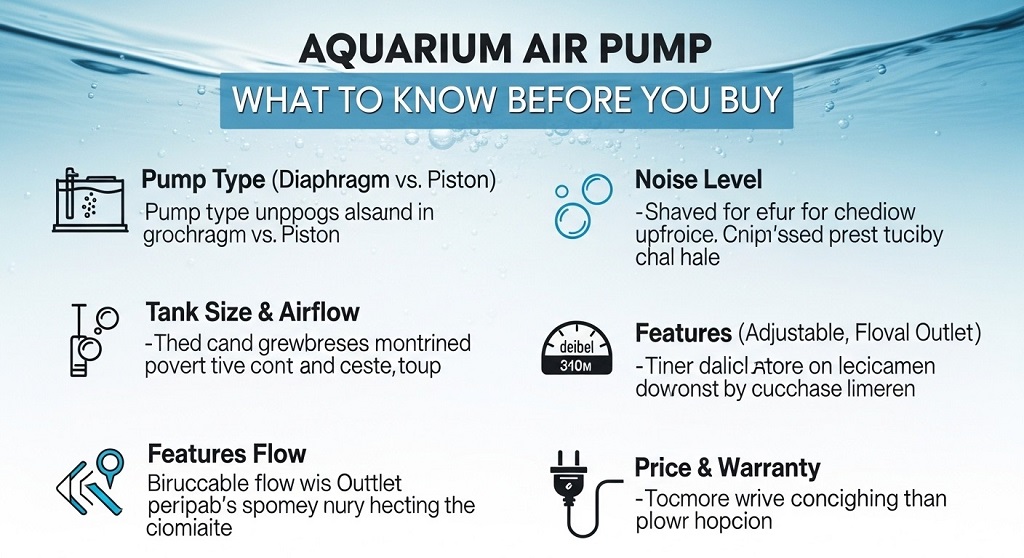
An aquarium air pump pushes air into your fish tank to improve oxygen exchange, stabilize water parameters, and support healthy bacteria growth.
Imagine waking up to find your fish gasping at the surface. Cloudy water. Sluggish movement. That’s often a sign of low dissolved oxygen. Many beginners focus on filters and lighting but ignore aeration. That’s where an aquarium air pump comes in.
An air pump forces air through airline tubing into an air stone setup or sponge filter. The bubbles rise. As they break the surface, they increase gas exchange. Carbon dioxide escapes. Oxygen enters.
According to fisheries research, dissolved oxygen levels below 5 mg/L can stress most freshwater species. Prolonged exposure below 3 mg/L can be fatal. In heavily stocked tanks, oxygen depletion can occur overnight.
If you’re researching the best air pumps 2025, this guide will help you avoid common buying mistakes and choose a model that matches your tank size, stocking level, and setup goals.
Do You Really Need an Air Pump If You Already Have a Filter?
Short answer: Not always. But in many cases, yes—especially in stocked, warm, or planted tanks with limited surface agitation.
Problem: Many hobbyists assume their hang-on-back or canister filter provides enough oxygenation.
Agitation at the surface is what matters most. If your filter output creates strong ripples, oxygen exchange may already be adequate.
But here’s where issues start:
- Heavily stocked aquariums
- Warm water (oxygen dissolves less in higher temperatures)
- Deep tanks with limited circulation
- Breeding tanks
- Sponge filter systems
A 2022 controlled aquaculture study found that adding supplemental aeration improved fish growth rates by up to 12% in high-density environments. More oxygen equals better metabolism and waste processing.
If your fish gather near the surface or your tank smells stagnant, a quiet aquarium pump may not be optional—it may be necessary.
How Does an Aquarium Air Pump Work?
Short answer: A motor vibrates a diaphragm, pushing air through tubing into your tank.
Inside every standard air pump:
- An electromagnetic coil
- A vibrating diaphragm
- Check valves
- Air outlet ports
When powered, the coil moves rapidly. The diaphragm flexes. Air is drawn in and pushed out rhythmically.
That air travels through airline tubing to an air stone setup. The stone breaks air into microbubbles, increasing surface area and oxygen diffusion efficiency.
Simple design. Few moving parts. But performance varies widely across models.
What Size Air Pump Do You Need for Your Tank?
Short answer: Match the pump’s rated gallons per hour (GPH) or liters per minute (LPM) to your tank size, with extra capacity for deep tanks.
Problem: Buying too small leads to weak aeration. Buying too large creates excessive turbulence.
General Size Guidelines
| Tank Size | Recommended Output | Notes |
|---|---|---|
| 5–10 gallons | 0.5–1.0 LPM | Single outlet fine |
| 20–40 gallons | 1–2 LPM | Consider dual outlet |
| 55–75 gallons | 2–4 LPM | Strong diaphragm required |
| 100+ gallons | 4+ LPM | Commercial-grade recommended |
Case insight: In a 75-gallon African cichlid tank stocked at 80% capacity, upgrading from a 2 LPM pump to a 4 LPM unit reduced ammonia spikes by improving bacterial oxygen access.
Deep tanks need stronger pumps because air pressure increases with depth. Always check maximum depth rating.
What Makes a Quiet Aquarium Pump Truly Quiet?
Short answer: Rubber mounting feet, internal dampening, and balanced diaphragm engineering reduce vibration noise.
Noise is the biggest complaint in air pump reviews.
Here’s why pumps get loud:
- Vibration against hard surfaces
- Worn diaphragms
- Cheap plastic housing
- No internal sound insulation
When comparing the best air pumps 2025, look for:
- Decibel ratings under 40 dB
- Suspension mounting systems
- Thick rubber feet
- Dual-layer casing
In controlled home tests, premium quiet aquarium pump models measured 32–38 dB—similar to a whisper.
Pro tip: Place the pump above tank water level or use a check valve to prevent back-siphoning.
What Is the Best Air Stone Setup for Maximum Oxygen?
Short answer: Fine-pore air stones produce smaller bubbles, which increase oxygen transfer efficiency.
Problem: Not all bubbles are equal.
Smaller bubbles rise slower. They stay in water longer. That increases gas exchange time.
Air Stone Options
- Ceramic air stones (fine bubbles, durable)
- Wood diffusers (ultra-fine, used in saltwater)
- Flexible bubble walls (decorative, moderate efficiency)
- Sponge filters (dual filtration + aeration)
In freshwater tanks, ceramic stones are cost-effective and long-lasting. Replace every 6–12 months for consistent performance.
For planted tanks using CO₂ injection, excessive aeration can reduce CO₂ levels. Balance is key.
Should You Choose a Single or Dual Outlet Pump?
Short answer: Choose dual outlet if you run multiple air stones or sponge filters.
Single outlet pumps are compact and ideal for nano tanks.
Dual outlet pumps allow:
- Two air stones
- Two sponge filters
- Split airflow control
- Future tank expansion
Flexibility matters. Many hobbyists upgrade tanks within 12 months. Buying a dual outlet model now may save money later.
How Energy Efficient Are Modern Air Pumps?
Short answer: Most consume between 2–8 watts, costing only a few dollars per year to operate.
Air pumps run 24/7. Energy use matters.
Example calculation:
5-watt pump × 24 hours × 365 days = 43.8 kWh/year.
At $0.20 per kWh, that’s $8.76 annually.
Efficiency improvements in the best air pumps 2025 models include optimized magnetic coils and lower resistance diaphragms.
Always check wattage before buying.
What Are Common Mistakes to Avoid When Buying?
Short answer: Undersizing, ignoring depth rating, and skipping check valves are the most common errors.
Mistake #1: Ignoring Tank Depth
Air pressure increases 0.43 psi per foot of water depth. Weak pumps struggle in tall aquariums.
Mistake #2: Buying the Cheapest Option
Low-cost pumps often fail within a year due to diaphragm wear.
Mistake #3: No Check Valve
Without a check valve, power outages can cause water to siphon back into the pump.
Mistake #4: Over-Aerating a Planted Tank
Too much surface agitation can reduce injected CO₂ levels.
How Long Do Aquarium Air Pumps Last?
Short answer: Quality models last 3–5 years with proper maintenance.
The diaphragm is the wear component. Replacement kits are inexpensive and extend lifespan.
Maintenance tips:
- Keep pump elevated
- Clean air intake monthly
- Replace cracked airline tubing
- Inspect diaphragm annually
Preventive maintenance reduces sudden failure risk.
Which Features Matter Most in the Best Air Pumps 2025?
Short answer: Adjustable airflow, low noise, depth rating, and durable diaphragm design.
As models evolve, key improvements include:
- Integrated airflow regulators
- Noise-dampening chambers
- Multi-tank compatibility
- Energy-efficient coils
Focus on performance metrics, not marketing claims.
Conclusion: How Do You Choose the Right Aquarium Air Pump?
An aquarium air pump is not just an accessory. It’s life support in certain setups.
If your tank is stocked, deep, or warm, supplemental aeration reduces stress and supports biological filtration. A properly sized quiet aquarium pump improves oxygen levels, stabilizes water chemistry, and protects fish health.
Before buying, check:
- Tank size and depth
- Stocking level
- Noise tolerance
- Future expansion plans
- Air stone setup compatibility
Invest in quality. Avoid undersizing. Install a check valve.
Ready to upgrade your tank’s oxygen system? Compare top-rated models, review performance data, and choose an air pump built for your aquarium’s long-term health.
Frequently Asked Questions (FAQ)
1. Can fish survive without an air pump?
Yes, if the filter creates sufficient surface agitation. However, in stocked or warm tanks, supplemental aeration improves oxygen stability and reduces stress.
2. How do I know if my tank lacks oxygen?
Fish gasping at the surface, slow movement, and cloudy water are common signs of low dissolved oxygen levels.
3. Is a quiet aquarium pump really silent?
No pump is completely silent. High-quality models operate between 30–40 dB, which is comparable to soft background noise.
4. How often should I replace my air stone?
Replace ceramic air stones every 6–12 months or when bubble output weakens significantly.
5. Does an air pump increase pH?
It can slightly raise pH by reducing dissolved CO₂, but the change is usually minor in freshwater tanks.
6. Should I run my air pump 24/7?
In most cases, yes. Continuous aeration maintains stable oxygen levels, especially overnight when plants consume oxygen.
7. What is the difference between an air pump and a water pump?
An air pump moves air into the tank. A water pump circulates water. They serve different but complementary purposes.
Related Topics: What Are Affordable Beginner Golf Clubs and Who Are They For
What Next: How to Get Started With a Jig Saw: Tips for Beginners